

Stories, discoveries, and everyday observations from younger writers across the Asia-Pacific
Young Voices features original English writing by primary and middle school contributors. It is a space where younger writers can share what they notice, experience, learn, read, and wonder about in their schools, families, communities, and everyday lives.
We welcome writing that is clear, sincere, and grounded in the contributor’s own experience or careful observation. A Young Voices article does not need to address a large or complicated issue. A small moment, a local place, an interesting person, or a new discovery can become a meaningful story when it is described thoughtfully.
What You Will Find
Young Voices may include:
- Personal stories and reflections
- School and community experiences
- Local traditions, places, and events
- Book and media responses
- Language-learning experiences
- Observations about nature and everyday life
- Age-appropriate interviews
- Short explanations of topics that interest the contributor
The strongest articles use specific details, follow a clear structure, and preserve the contributor’s own voice.
Writing for Young Voices
Recommended length:
- Primary school contributors: 150–250 words
- Middle school contributors: 250–400 words
The article must be originally written in English by the named contributor. A parent, teacher, tutor, or generative AI tool must not write, translate, or substantially rewrite the article on the contributor’s behalf.
For a contributor under 18, the article must be submitted by a parent or legal guardian. All editorial communication will also be conducted through that adult.
Only an approved publication name and a brief, non-identifying contributor biography will be displayed. Exact school names, personal contact details, and other unnecessary identifying information are not normally published.
Latest from Young Voices
Korean Food: A Shared Adventure
Article Type: Story · Open Access · Received: 28 July 2026 / Received in Revised Form: 30 July 2026 / Accepted: 1 August 2026 · Publication date: 3 August 2026.
So Ho Jung
Elementary School Student, Incheon Eunsong Elementary School, 460 Central-ro, Yeonsu-gu, Incheon, 22019, South Korea.
Copyright 2026 APALCE Voices This is an open access article distributed under the terms of the Creative Commons Attribution License 4.0, which permits unrestricted, distribution, and reproduction in any medium, provided the original work is properly cited.
Jung, S. H. (2026). Korean food: A shared adventure. APALCE Voices, 1.
Summary
From a child’s perspective, Korean food is presented as a communal experience shaped by varied flavours, family memories, and cultural traditions. The essay challenges the stereotype that Korean cuisine is always spicy, highlights a grandmother’s kimchijeon, and suggests that shared meals offer the most meaningful introduction.
Keywords
Korean cuisine; communal dining; kimchijeon; family traditions; cultural identity
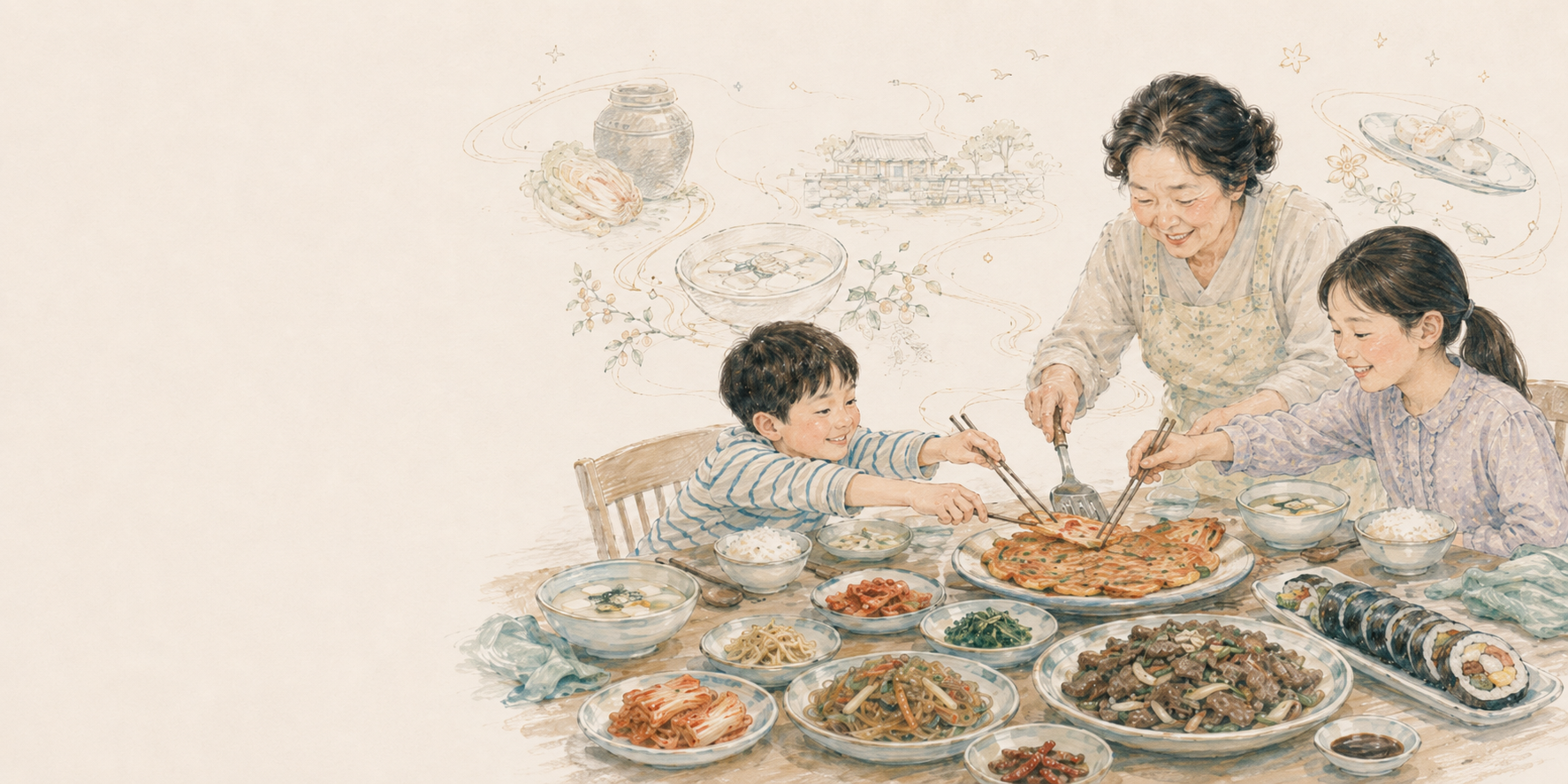
As a fifth-grade student in Korea, I see Korean food as more than something we eat; it is something we share. A Korean meal often comes with rice, soup, and several small side dishes called banchan. Everyone reaches towards the middle of the table, so mealtimes can feel rather democratic—until the last piece of something delicious appears.
Having lived in the UK, I know that some people imagine Korean food as a collection of very spicy dishes. It is true that chilli and kimchi are important, but Korean food has many gentler flavours too. Bulgogi is sweet and savoury, japchae is pleasantly chewy, and gimbap is easy to enjoy almost anywhere. There is usually a good starting point, even for someone who treats chilli like a fire alarm.
My favourite dish is my grandmother’s kimchi pancake, or kimchijeon. She mixes chopped kimchi into batter and fries it until the edges turn crisp while the centre remains soft. The smell travels through the house long before the pancake reaches the table. My younger brother and I may pretend to be patient, but the crispiest pieces rarely survive for long.
Korean food also carries stories. Kimchi shows how people preserved vegetables through winter, while foods such as tteokguk and songpyeon connect meals with holidays and family memories. The best introduction to Korean food, therefore, is not a list of names. It is a shared table, an open mind, and perhaps a spare pair of chopsticks.
References
Encyclopaedia Britannica. (2024). Kimchi. Encyclopedia Britannica. Retrieved 15 July 2026, from https://www.britannica.com/topic/kimchi.
Share Your Story
Do you have a story, observation, review, or discovery that you would like to share?
Please read the Submission Guidelines before completing the online submission form.
[Read the Submission Guidelines] [Submit an Article]