

Practical reflections on teaching, learning, and educational change
Teaching Notes presents accessible, experience-based writing by teachers, lecturers, professors, teacher educators, and other education professionals.
The channel is designed for educators who wish to reflect on what happens in classrooms and learning communities: what they tried, why they tried it, what they observed, what changed, and what others might learn from the experience.
Teaching Notes articles should be thoughtful and professionally grounded, but they do not need to follow the structure of a scholarly research paper. The emphasis is on clear communication, honest reflection, and practical relevance.
What You Will Find
Teaching Notes may include:
- Reflections on classroom practice
- Teaching activities and lesson ideas
- Materials and resource use
- Language teaching and learning
- Assessment and feedback
- Curriculum implementation
- Teacher development
- Educational technology
- Inclusive and intercultural education
- Challenges encountered in teaching
- Reflections on educational change
A strong article does more than describe an activity. It explains the context, the educational purpose, what happened, and what the writer learned.
Writing for Teaching Notes
Recommended length: 600–1,000 words
Contributors should:
- Describe the teaching context clearly
- Explain the purpose of the activity or decision
- Provide enough detail for readers to understand the experience
- Reflect on both strengths and limitations
- Avoid presenting a single experience as universally applicable
- Protect student and colleague privacy
- Disclose relevant professional or institutional interests
Student names, exact class information, personal records, photographs, and identifiable classroom details must not be included without appropriate permission. Anonymisation may still be required even when consent has been obtained.
Teaching Notes is not a peer-reviewed scholarly publication, and publication does not constitute validation of a teaching method or research finding.
Latest Teaching Notes
The Potential and Challenges of Using K-pop in Korean Language Education
Article · Open Access · Received: 28 July 2026 / Received in Revised Form: 30 July 2026 / Accepted: 1 August 2026 · Publication date: 3 August 2026 · DOI: 10.23404/apalcevoices.2026.1.1
Chae Kwan Jung
Associate Professor, Department of English Language and Literature, Incheon National University, 119 Academy-ro, Yeonsu-gu, Incheon, 22012, South Korea.
Copyright 2026 APALCE Voices This is an open access article distributed under the terms of the Creative Commons Attribution License 4.0, which permits unrestricted, distribution, and reproduction in any medium, provided the original work is properly cited.
Summary
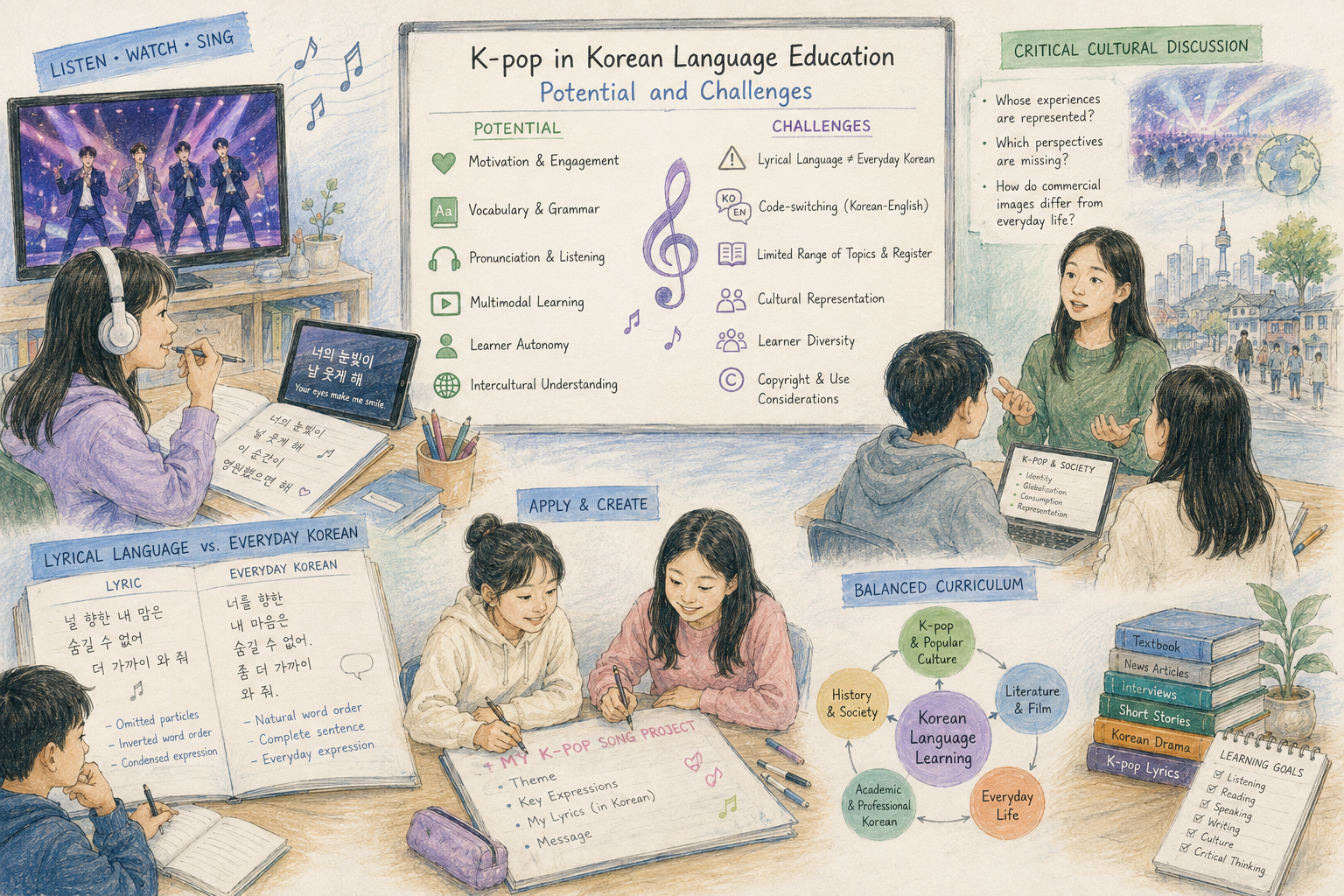
K-pop can be a valuable supplementary resource in Korean language education by strengthening motivation, supporting vocabulary retention, drawing attention to pronunciation, and enabling multimodal learning. Its usefulness, however, depends on careful pedagogical design. Song lyrics often contain omissions, altered word order, figurative language, pronunciation changes, and Korean–English code-switching, making them unreliable models of everyday speech. Their thematic and linguistic range is also limited, while uncritical use may oversimplify Korean culture or exclude learners uninterested in K-pop. Effective instruction should therefore begin with clear objectives, connect lyrical expressions to authentic communication, address copyright, and encourage critical cultural reflection.
Keywords
K-pop; Korean language education; learner motivation; multimodal learning; critical cultural literacy
K-pop offers considerable pedagogical potential because it can convert a general interest in Korean culture into sustained engagement with the Korean language. The wish to understand the nuances of a favourite song, follow an artist’s interview without subtitles, or communicate with other fans in Korean gives learners a clear and personally meaningful purpose for study. Korean may consequently be perceived not simply as a language that must be learned, but as one that learners actively wish to acquire. This motivation can extend well beyond the classroom, as music, videos, interviews, and online fan communities provide continuing opportunities for exposure, participation, and independent learning.
The repetitive structure of popular music also lends itself to the acquisition of vocabulary and grammatical expressions. Words relating to emotions and interpersonal relationships, together with frequently repeated adverbs and sentence patterns, may become especially memorable when embedded in a familiar melody or chorus. Listening and singing activities can likewise direct learners’ attention to features of Korean pronunciation, including syllable structure, final consonants, sound linking, contraction, and rhythm. When songs are combined with music videos, subtitles, interviews, and fan commentary, they can support multimodal learning across listening, reading, speaking, writing, translation, and cultural interpretation. A single song may therefore provide the basis for a varied and integrated sequence of language-learning activities.
These benefits should not, however, obscure the linguistic particularities of song lyrics. Lyrics cannot automatically be treated as representative models of everyday Korean. To accommodate rhythm, melody, and syllable count, lyricists frequently omit particles, alter conventional word order, employ incomplete clauses, and modify pronunciation. Figurative and highly compressed expressions are also common. In addition, code-switching between Korean and English has become a prominent feature of contemporary K-pop. Although this offers valuable material for advanced discussions of identity, globalisation, and multilingual creativity, it may make it difficult for beginning learners to distinguish Korean grammatical structures and lexical patterns. The pronunciation and rhythm of sung Korean may also differ substantially from those of ordinary spoken interaction. Teachers therefore need to explain where and why particular expressions occur and to compare lyrical forms with the expressions that speakers would more naturally use in everyday conversation.
A further limitation concerns the range of language represented in K-pop. Songs frequently address love, separation, youth, identity, aspiration, and success, making them a rich source of vocabulary associated with emotions and personal relationships. They are much less suited to the systematic teaching of Korean for academic, professional, or public purposes. Honorific usage, extended explanation, formal argumentation, reporting, and the management of sustained interaction are unlikely to be adequately represented through song lyrics alone. An overreliance on K-pop may therefore produce an uneven linguistic repertoire, particularly when learners require Korean for study, employment, or institutional communication.
Similar caution is needed when K-pop is used as a source of cultural knowledge. K-pop forms an influential part of contemporary Korean culture, but it does not represent Korean society in its entirety. If presented without critical discussion, it may encourage an overly narrow image of Korea centred on youth, physical appearance, consumption, competition, and romantic relationships. Learners should therefore be invited to consider whose experiences are represented, which social perspectives remain absent, and how commercial images differ from everyday life. Such discussion can help them approach K-pop not simply as an authentic cultural product, but as a constructed discourse shaped by particular industries, audiences, and global markets.
Learner diversity must also be taken into account. Not all students are interested in K-pop, while those who are may differ considerably in their preferred artists, genres, and levels of engagement. K-pop should consequently remain one resource among a broader range of cultural and linguistic materials rather than become the organising principle of an entire programme. Practical issues of copyright and permitted use also require careful attention when lyrics, recordings, videos, photographs, and subtitles are reproduced or distributed for educational purposes.
K-pop is thus most productively understood as a supplementary resource rather than a substitute for a comprehensive Korean language curriculum. Effective instruction should begin with clearly defined learning objectives, followed by the selection of a song or brief lyrical extract that serves those objectives. The educational value of K-pop lies not in its popularity alone, but in the activities constructed around it. Learners need opportunities to move beyond listening and appreciation, compare lyrical language with everyday usage, and apply newly encountered expressions through speaking and writing. When such work is combined with critical reflection on cultural values and social representations, K-pop can make a distinctive contribution to Korean language education by supporting motivation, linguistic development, learner autonomy, and intercultural understanding.
References
Suh, J., & Park, E. S. (2025). BTS and Languages: K-pop Transcending Language and Communication. Routledge.
Share What You Have Learned
A classroom experience does not need to be perfect to be worth sharing. Honest reflection on a challenge, adjustment, or unexpected result can be especially useful to other educators.
[Read the Submission Guidelines] [Submit an Article]