
Thoughtful reviews and reflections on stories, performances, and creative work
Books, Media & Arts features original English reviews, essays, and reflections on the creative works that shape how we understand ourselves and the world.
The channel is open to contributors from different age groups and backgrounds. Articles may discuss works from the Asia-Pacific or examine how books, films, music, performances, and digital media travel across languages and cultures.
A strong article does more than summarise a plot or describe whether the contributor liked the work. It introduces the work clearly, develops a particular perspective, uses carefully selected examples, and explains why the work may matter to readers.
What You Will Find
Books, Media & Arts may include:
- Book reviews
- Film and television reviews
- Theatre and performance reflections
- Exhibition and museum reviews
- Music and album discussions
- Podcast reviews
- Game and digital-media criticism
- Reflections on translation and adaptation
- Comparisons between related creative works
- Interviews with writers, artists, performers, or creators
- Essays on art, culture, and representation
Writing for Books, Media & Arts
The recommended length depends on the contributor’s age and article type. Please refer to the Submission Guidelines.
A strong review should:
- Identify the work and its creator accurately
- Provide enough context for readers unfamiliar with it
- Avoid excessive plot summary
- Develop a clear point of view
- Support observations with specific examples
- Distinguish personal preference from critical evaluation
- Consider the work’s cultural, educational, or artistic significance
- Avoid revealing major plot developments without an appropriate notice
Contributors must respect copyright. Do not reproduce long passages, song lyrics, scripts, subtitles, screenshots, photographs, book illustrations, or promotional images without permission. Short references may be used only where appropriate and properly acknowledged.
Latest from Books, Media & Arts
Book Review: English Corpus Linguistics Made Easy
Article · Open Access · Received: 28 July 2026 / Received in Revised Form: 30 July 2026 / Accepted: 1 August 2026 · Publication date: 3 August 2026.
Young Ok Jong
Visiting Research Fellow, Institute of Foreign Language Education, Hankuk University of Foreign Studies, 107 Imun-ro, Dongdaemun-gu, Seoul, 02450, South Korea.
Copyright 2026 APALCE Voices This is an open access article distributed under the terms of the Creative Commons Attribution License 4.0, which permits unrestricted, distribution, and reproduction in any medium, provided the original work is properly cited.
Jong, Y. O. (2026). Book review: English corpus linguistics made easay. APALCE Voices, 1.
Summary
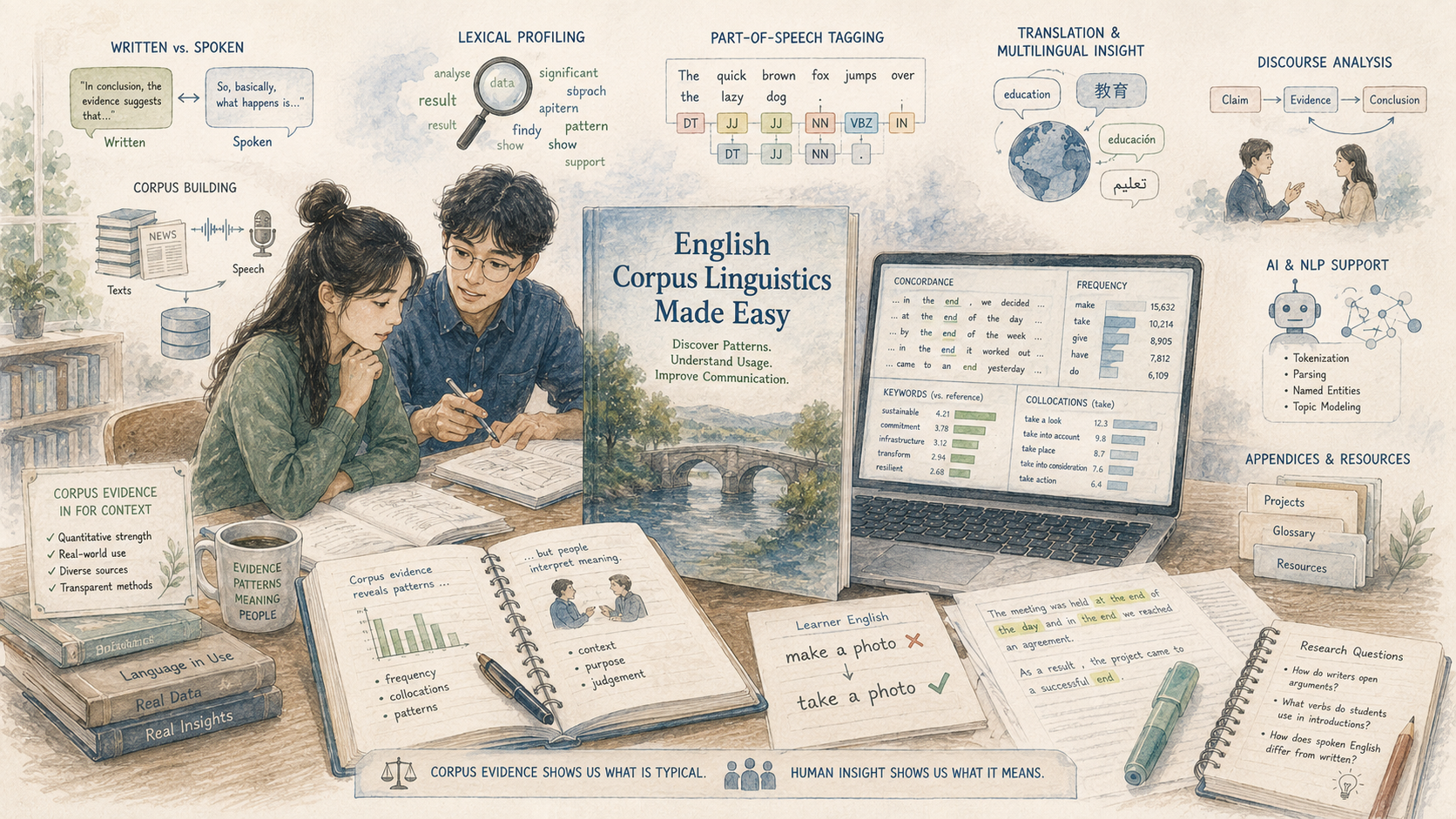
Chae Kwan Jung’s English Corpus Linguistics Made Easy introduces corpus linguistics as an accessible, evidence-based approach to understanding language in use. Moving from key concepts to practical tools such as AntConc, AntWordProfiler, and TagAnt, it guides readers through corpus construction, analysis, and interpretation. The book connects corpus methods with language education, translation, discourse studies, AI, and learner-language analysis while acknowledging their interpretive limits. Designed for students, teachers, translators, and novice researchers, it encourages readers to move beyond intuition and become active investigators of patterned, socially situated English.
Keywords
Corpus linguistics; data-driven language study; corpus analysis tools; learner language; English language education
Chae Kwan Jung’s English Corpus Linguistics Made Easy begins with a deceptively simple proposition: English is best understood not only through rules and intuition, but also through evidence of how people actually use it. Corpus-based approaches now inform language education, translation, discourse analysis, and artificial intelligence, yet the field’s terminology and analytical tools can still appear daunting to newcomers. The book’s principal achievement is to make this area accessible without reducing it to a collection of technical procedures.
The volume moves carefully from conceptual foundations to practical inquiry. The first chapter introduces central ideas such as representativeness, sampling, frequency, keywords, collocation, and recurring patterns. Just as importantly, it acknowledges the limitations of corpus evidence. Numerical regularities may reveal important tendencies, but they cannot fully explain context, intention, or social meaning without informed interpretation. This balanced treatment helps readers understand corpus linguistics as an empirical approach rather than an unquestioning reliance on numbers.
The second chapter turns from principles to practice through AntConc, AntWordProfiler, and TagAnt. Readers are guided through frequency analysis, concordance lines, collocations, lexical profiling, and part-of-speech tagging. The explanations proceed gradually and assume little prior experience with computational methods. Particularly valuable is the guidance on constructing small corpora from written texts, spoken material, and learners’ own language production. Readers are thus invited to participate in the full process of inquiry: collecting, cleaning, analysing, comparing, and interpreting data.
The third chapter demonstrates how these methods can illuminate meaningful differences in English use. Written and spoken language are compared across genres, while recurrent features of Korean learners’ English are examined through overuse, underuse, literal translation, grammatical patterns, and collocational choice. An example such as make a photo rather than take a photo shows how corpus evidence can make visible a pattern that might otherwise remain an impression based largely on teacher intuition. This connection between empirical analysis and pedagogical decision-making is one of the book’s strongest features.
The scope extends beyond conventional language teaching to translation, social and cultural discourse, artificial intelligence, and natural language processing. The appendix reinforces this applied orientation through small-scale project ideas, guided activities, recommended readings, online corpus resources, and a glossary. These materials make the book adaptable for university courses, teacher development, independent study, and introductory research projects.
As an introductory volume, the book does not attempt to provide advanced statistical training, programming-based analysis, or a comprehensive account of corpus research design. Readers wishing to pursue these areas will need more specialised sources. This is less a weakness than a consequence of the book’s clearly defined purpose: to provide a manageable and intellectually credible point of entry.
The book’s lasting value lies not simply in teaching readers how to operate corpus software. More significantly, it encourages them to question intuition, examine evidence, and recognise language as patterned yet socially situated. Students, teachers, translators, and beginning researchers are positioned not as passive recipients of linguistic rules, but as active investigators of language in use.
References
Jung, C. K. (2026). English Corpus Linguistics Made Easy. Incheon National University Press.
Share a Thoughtful Review
Has a book, film, performance, exhibition, podcast, song, or game changed the way you see an issue, a culture, or an experience?
Introduce it to APALCE Voices readers through an original and carefully developed article.
[Read the Submission Guidelines] [Submit an Article]